The moment an assessment is published, the system it describes continues to move. Product teams merge features. Automation updates lockfiles. Platform teams change base images and shared workflows. Services appear, split, or retire. Ownership shifts. A passing test becomes flaky, a new dependency enters a production path, or a blocker disappears because another team completed work ahead of schedule.
Migration programs often respond by freezing documents and asking teams to report changes manually. That approach creates a widening gap between the plan and reality. Coordinators spend time reconciling spreadsheets, engineers receive tasks based on obsolete evidence, and cutover reviews debate which status is current. The larger and longer the migration, the greater the drift.
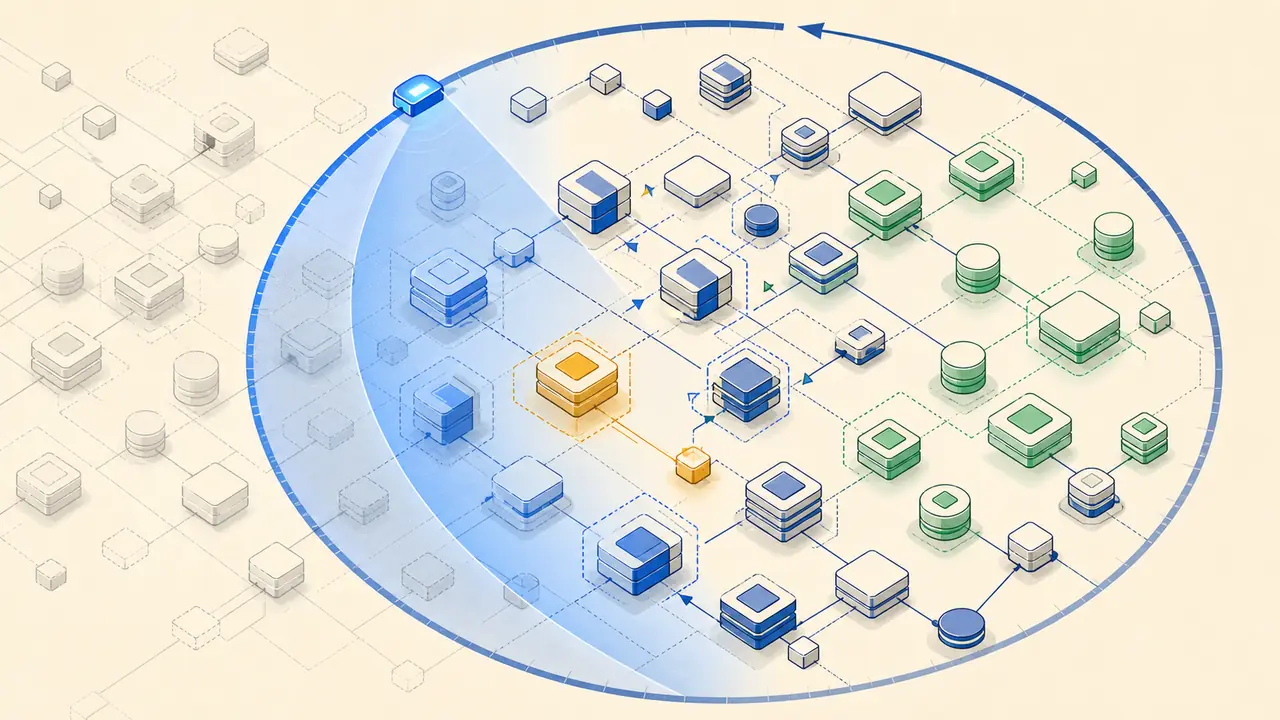
Continuous rescanning replaces manual reconciliation with an evidence lifecycle. It analyzes reproducible repository states, compares them with prior snapshots, explains relevant deltas, updates findings and dependency paths, recalculates readiness and estimates, and sends the right changes to owners. It does not mean rerunning everything after every keystroke. It means maintaining deliberate, current control over the assumptions that support execution.
Why migration plans drift
A migration plan is built from a set of facts: versions, APIs, dependency relationships, workflow configuration, images, infrastructure, tests, owners, and environments. Each fact has a source and a time. When any source changes, downstream conclusions may change. Updating a shared package can resolve several service blockers. Adding one native dependency can invalidate target-runtime readiness. Moving a build to a reusable workflow can transfer responsibility to another repository.
Not all drift comes from migration work. Security patches update transitive dependencies. Feature delivery adds endpoints without contract coverage. Cost work changes container bases. Reliability work adjusts health probes. Organization changes alter code ownership. A separate modernization initiative may overlap the same infrastructure. The migration control system must observe normal delivery rather than demanding that it stop.
Documents drift because their statements are not connected to sources. A cell marked “compatible” does not know which lockfile version supported it. A task named “update CI” does not know which workflow path triggered it. Without traceability, every refresh requires another discovery meeting.
Drift also affects sequence. A shared dependency completed early can unlock parallel waves; a new service relationship can create a critical path; an owner’s change can introduce an approval lead time. A static plan can be simultaneously on schedule and technically impossible.
A readiness claim is valid only for the commits, configuration, rule versions, and evidence timestamps that produced it.
Make every scan a reproducible snapshot
A rescan should begin by resolving repositories and branches to exact commits. Record the scan scope, commit set, analysis rule versions, configuration, environment mappings, and timestamp. If the assessment includes shared workflow or infrastructure repositories, pin them too. The snapshot becomes the reference behind every finding and score.
Reproducibility allows teams to answer two questions separately: did the system change, or did analysis knowledge change? A repository commit delta indicates source movement. A Migration Pack rule update can identify a previously unknown incompatibility without any source change. Both are valuable, but they require different explanations and owner actions.
Normalize identities across scans. A repository rename, workspace move, or service-catalog identifier change should not appear as one component removed and another added when the underlying service is continuous. Preserve stable identifiers and aliases, then expose true structural changes for review.
Store evidence provenance. Package facts should link to manifests and lockfiles; runtime selection to workflows, images, or platform configuration; code patterns to files and lines; ownership to reviewed sources; operational controls to tests, dashboards, and runbooks. This makes each delta inspectable rather than a black-box score movement.
Handle unavailable sources explicitly. If a repository cannot be read or a branch no longer exists, do not silently retain old findings as current. Mark evidence stale or scope incomplete, lower confidence where appropriate, and create a review condition. Absence of new evidence is not proof that the old state remains.
Design deltas that support decisions
A raw source diff is too detailed for program control, while a changed readiness percentage is too abstract. The useful layer is a semantic migration delta: what changed in the facts, why it matters to the target transition, which components and tasks are affected, and what decision follows.
Classify component deltas: repository added or removed, service identity changed, dependency introduced or upgraded, runtime pin changed, image digest changed, workflow path changed, infrastructure relationship added, test coverage detected, owner changed, or environment mapping updated. Each category has different downstream logic.
Classify finding deltas separately. A finding may be new, resolved, regressed, changed in severity, changed in confidence, moved to manual review, suppressed by an approved exception, or reopened because its closure evidence is no longer valid. Preserve the prior state and reason.
Show impact-path deltas. If a shared package gains three consumers, the underlying compatibility finding may remain identical while blast radius and work sequence change. If a service no longer deploys to production, a finding can remain technically true but lose cutover relevance. Typed graph comparisons reveal these distinctions.
Connect deltas to tasks. A newly resolved blocker can unblock adoption work. A changed file path may require task evidence to be refreshed but not reopen the work. A new direct dependency can add acceptance criteria. Notify owners with the smallest useful explanation: source, change, impact, and recommended response.
Every important delta should answer
- What fact, relationship, rule, or evidence state changed?
- Which previous and current snapshots prove the change?
- Which findings, components, tasks, waves, and gates are affected?
- Did severity, confidence, effort, or readiness move?
- Who needs to review or act, and by when?
Manage findings as a lifecycle, not a refreshed list
Stable finding identity is essential. When the same incompatible package appears at a new line after a manifest edit, the system should preserve its history rather than close one record and create another. Identity can combine rule, component, dependency, and normalized evidence location, with logic for moves and renames.
Resolution requires positive evidence. If a package is upgraded to a compatible version, record the new resolved version and rule result. If the dependency is removed, record that the affected path no longer exists. If a repository leaves scope, classify the finding as out of scope rather than remediated. If analysis fails to parse the file, mark evidence unavailable instead of closing.
Exceptions need boundaries. An accepted risk should record approver, rationale, scope, expiration, compensating controls, and evidence. A rescan should reopen it when the relevant version, component, environment, or expiry changes. Permanent blanket suppression hides drift precisely where scrutiny is needed.
Manual reviews also have a lifecycle. Record the question, reviewer, answer, supporting evidence, and freshness rule. For example, a team may confirm that a conditional dependency is disabled in production; a later configuration change should invalidate that assertion automatically.
Preserve history for analysis. Teams should be able to see when a blocker appeared, how long it remained, which tasks addressed it, why it reopened, and what evidence finally closed it. This supports governance and improves future migration rules.
Recalculate readiness, effort, and sequence transparently
Readiness should respond to current evidence across meaningful dimensions: dependency compatibility, code remediation, test strength, infrastructure, delivery, operations, ownership, documentation, and rollback. A new blocker can cap readiness regardless of improvements elsewhere. Missing evidence should reduce confidence rather than being treated as success.
Explain score movement. “Readiness increased from 72 to 76” is incomplete. State that a shared-package blocker was resolved, target CI passed in four additional services, and one rollback review remains pending. If scoring weights or rule versions changed, identify that separately from engineering progress.
Effort ranges should update when scope, findings, or actual outcomes change. A new consumer increases adoption work; removing an obsolete service reduces it; an early wave that required more contract testing can recalibrate remaining tasks. Preserve assumptions and revision history so stakeholders can understand the change.
Migration waves may need resequencing. Resolved foundations can unlock services; a new cycle can force grouping; an unavailable owner can move operational work; a regression may pause the next wave. Replanning should respect completed evidence and minimize churn. Do not reorder work merely because a score changed—show the dependency or risk reason.
Cutover gates should consume current task and validation state. A gate can become stale if the assessed commit differs from the candidate artifact, if a test expires under policy, or if the environment changes. Freshness is part of gate status, not a note outside it.
Choose a rescan cadence that matches change
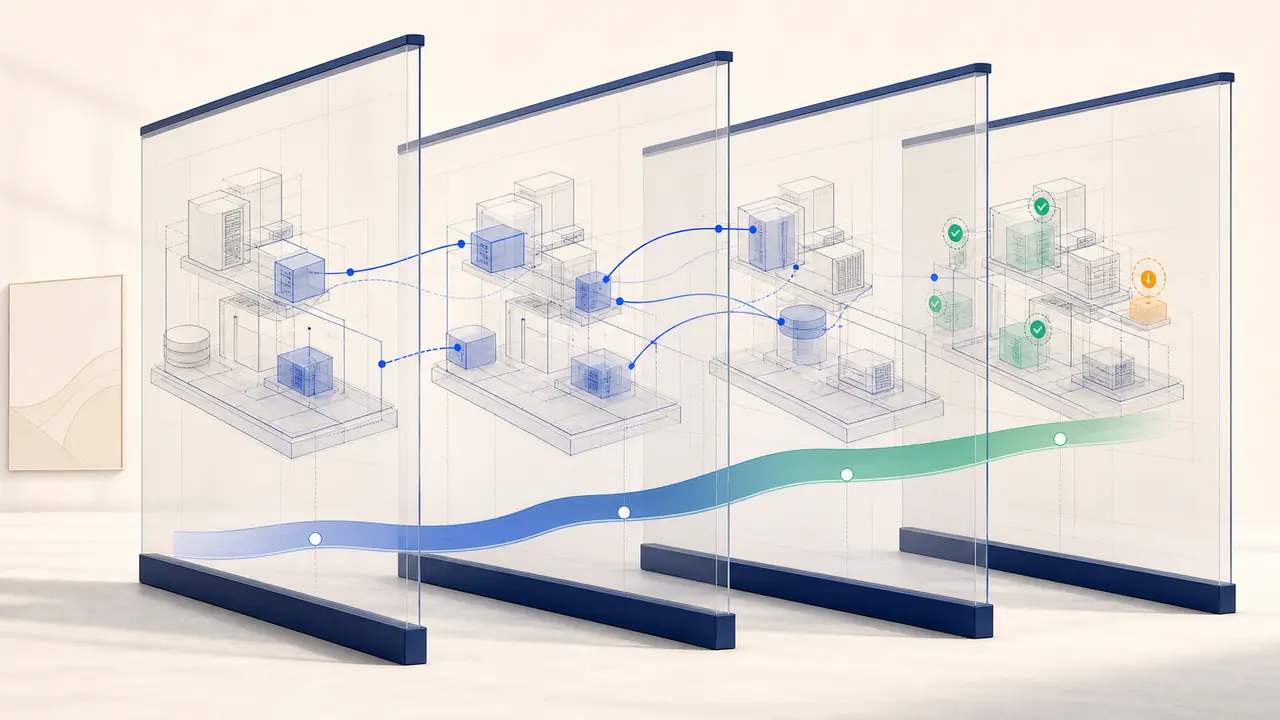
Different triggers serve different decisions. Pull-request analysis provides early feedback on whether a change introduces or resolves migration impact. Merge-based scans keep the canonical branch current. Scheduled scans catch automation, external metadata, rule updates, and repositories with low activity. Pre-wave and pre-cutover scans establish formal gate snapshots.
Use risk to tune cadence. Shared packages, base images, central workflows, and critical services deserve faster scanning because one change can affect many paths. Stable archival repositories need less frequent work. A program-wide default is useful, but topology should refine it.
Incremental analysis can keep feedback timely. Determine which rules and dependency neighborhoods are affected by changed files, then recompute the necessary paths. Periodic full scans protect against missed relationships and analysis changes. Both modes should produce comparable evidence and stable identities.
Coordinate with release processes. A pre-cutover scan should analyze the exact release commits, workflow revisions, image digests, and infrastructure configuration intended for production. Scanning a branch head while deploying a different artifact creates false confidence.
Define service-level expectations for evidence freshness. A critical cutover may require repository facts from the release candidate, tests from the current artifact, rollback access checked that day, and manual approvals within a specific window. Less volatile evidence can remain valid longer.
Control noise without losing important change
Continuous scanning fails when every source edit creates a broad alert. Route notifications by ownership and materiality. A task owner needs changes affecting acceptance; a platform lead needs new central blockers; program leadership needs readiness, critical-path, or cutover-gate movement. Everyone does not need every file observation.
Group related deltas. One lockfile update may alter dozens of transitive nodes but represent one actionable dependency change. Present the summary with expandable paths and evidence. Preserve technical detail without forcing operators to interpret raw graph churn.
Deduplicate stable findings and suppress repeated notifications when no actionable field changed. A blocker that remains open should stay visible in the control view, but it need not alert its owner on every scan. Notify on creation, material impact change, approaching deadline, stale review, or reopening.
Use confidence to route review. High-confidence deterministic findings can create or update tasks automatically under policy. Inferred ownership or dynamic relationships may require confirmation before changing sequence. AI-generated summaries should never upgrade uncertainty into fact.
Track scan health. Parsing errors, inaccessible repositories, outdated rules, missing commits, or failed graph resolution are themselves control signals. A clean-looking report built from partial scope is more dangerous than a visible warning.
Require freshness at the cutover gate
Before production transition, bind the assessment to the release candidate. Confirm source commits, dependency lockfiles, image digests, workflow revisions, infrastructure configuration, environment, and Migration Pack versions. Compare this snapshot with the latest approved state and review every material delta.
Ensure no blocker reopened and no critical component entered scope without validation. Confirm tests and performance results belong to the candidate artifact. Verify monitoring, error thresholds, rollback artifacts, permissions, and required approvals remain current. A green gate from an older commit is historical evidence, not a cutover result.
Freeze only what is necessary. A controlled release boundary can stop unreviewed changes from entering the candidate while normal work continues elsewhere. Record any cherry-picks or emergency edits and trigger targeted rescanning. The objective is exact scope, not broad organizational inactivity.
During rollout, production evidence becomes part of the current state. Attach deployment results, health signals, observations, and exceptions. If a stop condition triggers, preserve the snapshot and timeline supporting the rollback decision. After stabilization, create the post-cutover baseline from the state actually operating.
A continuous migration-control operating model
- Snapshot: resolve all repositories, workflows, images, and configuration to exact versions.
- Analyze: apply deterministic, versioned migration rules to relevant evidence.
- Map: update typed dependency, environment, validation, and ownership relationships.
- Compare: generate semantic deltas against the prior approved snapshot.
- Reconcile: preserve finding history and resolve, reopen, or review with explicit reasons.
- Recalculate: update impact, confidence, effort ranges, readiness, waves, and gates.
- Route: deliver material changes to accountable owners with evidence paths.
- Decide: review deltas at wave and cutover checkpoints under human control.
- Learn: compare expected and observed outcomes after production and cleanup.
Assign governance for the model itself. Rule owners maintain compatibility knowledge. Platform owners confirm shared delivery facts. Service owners review component-specific evidence. Migration leadership manages exceptions, freshness policies, and wave decisions. Security and operations own their cutover controls. Clear stewardship prevents the scan from becoming another unowned report.
Measure useful outcomes: age of critical evidence, time from new blocker to ownership, percentage of findings with reproducible provenance, unresolved scope gaps, stale exceptions, cutover gates tied to candidate artifacts, and estimate calibration after waves. Avoid optimizing raw scan frequency when teams cannot interpret or act on the output.
Protect source code throughout analysis. Use read-only access by default, short-lived credentials, isolated workers, restricted networking, controlled lifecycle scripts, configurable retention, audit logs, and customer-controlled deletion. Continuous operation increases the importance of disciplined access boundaries.
Define an escalation path when evidence systems disagree. A manifest may declare one runtime while a production image uses another; ownership files may conflict with the service catalog; a passing static rule may conflict with a failed target build. Preserve each source, apply a clear precedence policy where one exists, and route unresolved conflicts to the accountable reviewer. Do not average contradictory facts into a reassuring score. The conflict itself is a readiness condition until teams establish which state governs production.
Retain efficient historical snapshots without treating source archives as the only answer. Store normalized facts, provenance, rules, and deltas according to retention policy, and allow customer-controlled deletion of repository content. Teams should be able to reconstruct why a decision was made while respecting code-retention boundaries. Stable evidence identifiers and commit references provide durable auditability even when ephemeral analysis workspaces have been destroyed.
Conclusion
A migration plan remains trustworthy only while its evidence reflects the system being changed. Continuous rescanning creates that connection. Reproducible snapshots establish facts, semantic deltas explain movement, lifecycle controls preserve finding meaning, and transparent recalculation keeps effort, sequence, and readiness current.
The goal is not constant activity or more alerts. It is timely decision support: the right owner sees the right change, with its source and impact, before an obsolete assumption reaches cutover. When current repository evidence, validation results, rollback state, and human approvals converge on the exact release candidate, modernization becomes a continuously controlled engineering process.
Keep the plan synchronized with the code.
CutoverGrid continuously rescans repository state, explains migration deltas, updates readiness, and verifies current evidence before each wave and production cutover.