Readiness
78%
Connect your repositories, map impact, and move to the next stack with confidence.
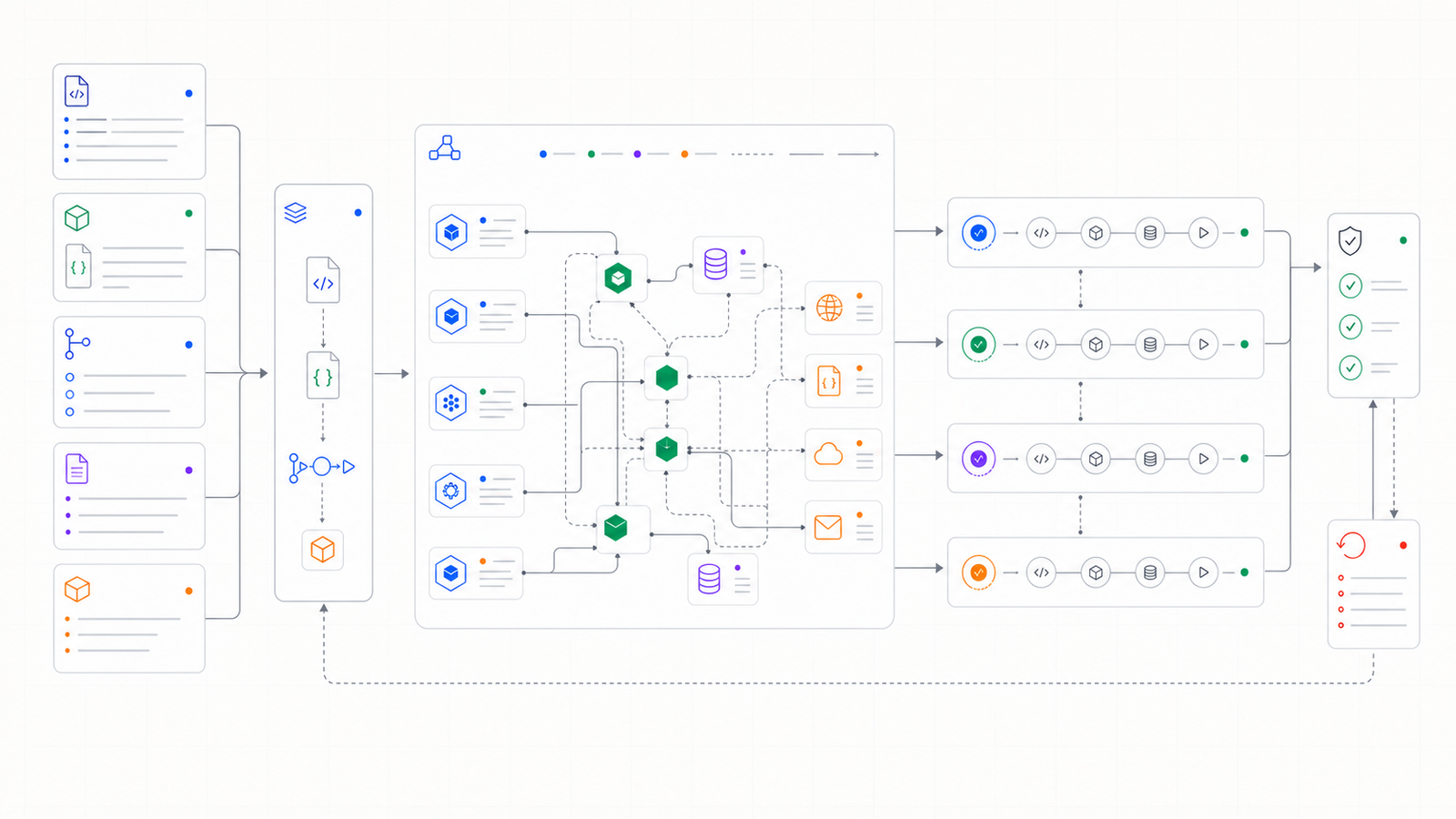
Automatically discover dependencies across repositories and runtimes.
Plan, sequence, and track waves with clear ownership and timing.
Run pre-cutover checks and monitor health to cut over with confidence.
CutoverGrid turns repository state, dependencies, infrastructure, delivery workflows, team ownership, and production safeguards into one continuously updated plan.
Explore the productApplications, shared packages, infrastructure, and delivery configuration.
Each connected to a commit, rule, file, affected service, and owner.
Sequenced by shared dependency, operational risk, and rollback boundary.
Build, test, performance, monitoring, rollback, and approval conditions.
Every stage adds evidence, ownership, or control to the same migration record.
Connect repositories and create reproducible commit-pinned snapshots.
Identify runtimes, frameworks, packages, tooling, and environments.
Reveal cross-repository dependencies, services, owners, and data paths.
Detect compatibility blockers, missing safeguards, and unknowns.
Model effort as a range with assumptions and calibrated confidence.
Compare strategies and turn findings into sequenced technical work.
Assign owners, dependencies, acceptance criteria, and rollback steps.
Evaluate engineering and operational gates before production cutover.
Compare predicted and actual outcomes to strengthen the next migration.
Move from executive readiness to file-level evidence without leaving the migration record.
Dependency and toolchain preparation are progressing. Test and rollback readiness require attention.
package-lock.json · sharp@0.31HighRebuild against target runtime.github/workflows/test.yml:22HighAdd target runtime matrixpackages/auth/package.jsonHighPublish compatibility releasesrc/routes/checkout.ts:84MediumAdd consumer contractsdeploy/production.yaml:48MediumRun restore validationRecord health baselines, add contract tests, verify rollback artifacts, confirm ownership.
Add the target runtime to CI, update build tooling, rebuild native packages, update images.
Publish compatibility versions and verify every downstream consumer.
Upgrade workers, validate staging behavior, and compare runtime performance.
Upgrade customer-facing APIs and complete operational approval.
Route traffic progressively and enforce health-based rollback thresholds.
Remove compatibility flags, legacy jobs, obsolete images, and outdated guidance.
Every blocker, estimate, task, and gate remains connected to the code and rule that created it. Teams can review the evidence, correct assumptions, and understand exactly why the plan changed.
See the evidence modelNine connected capabilities turn migration discovery into verified operational execution.
Repository and branch discovery with narrowly scoped access.
View detailed capability →Reproducible analysis tied to an exact code and configuration state.
View detailed capability →Services, packages, data, infrastructure, environments, and owners connected.
View detailed capability →Runtime, dependency, native-module, CI, container, build, and test analysis.
View detailed capability →Every material finding linked to its repository, commit, path, rule, and confidence.
View detailed capability →Transparent scores across code, dependencies, tests, infrastructure, and operations.
View detailed capability →Engineering-day ranges, explicit assumptions, and comparable migration paths.
View detailed capability →Sequenced tasks, owners, acceptance criteria, validation, and rollback conditions.
View detailed capability →Readiness recalculation, blocker tracking, technical gates, and completion evidence.
View detailed capability →Maintaining deeper rules for runtime, framework, database, delivery, and platform transitions.
Connecting shared packages and cross-repository blockers to the teams that can resolve them.
Keeping GitHub, Jira, and Linear work aligned with live migration evidence.
Increasing private deployment, retention, and isolated worker controls.
Grounding assisted code changes in deterministic checks and human review.
Giving leaders one portfolio view across deadlines, risk, effort, and team capacity.
CutoverGrid combines least-privilege access, short-lived credentials, tenant isolation, restricted workers, retention controls, and customer-controlled deletion.
Start with a readiness scan and expand across active modernization programs.
Establish the current state of one repository.
Plan and control one active migration.
Coordinate several migrations across teams.
Operate modernization as an organization-wide program.
Connect your repositories, validate the evidence, and move from assessment to verified production cutover.