Define
Specify the transition boundary, supported variants, and exclusion conditions.
Active initiative · 01
Deeper versioned intelligence for runtime, framework, database, delivery, infrastructure, and platform transitions.
Capability overview
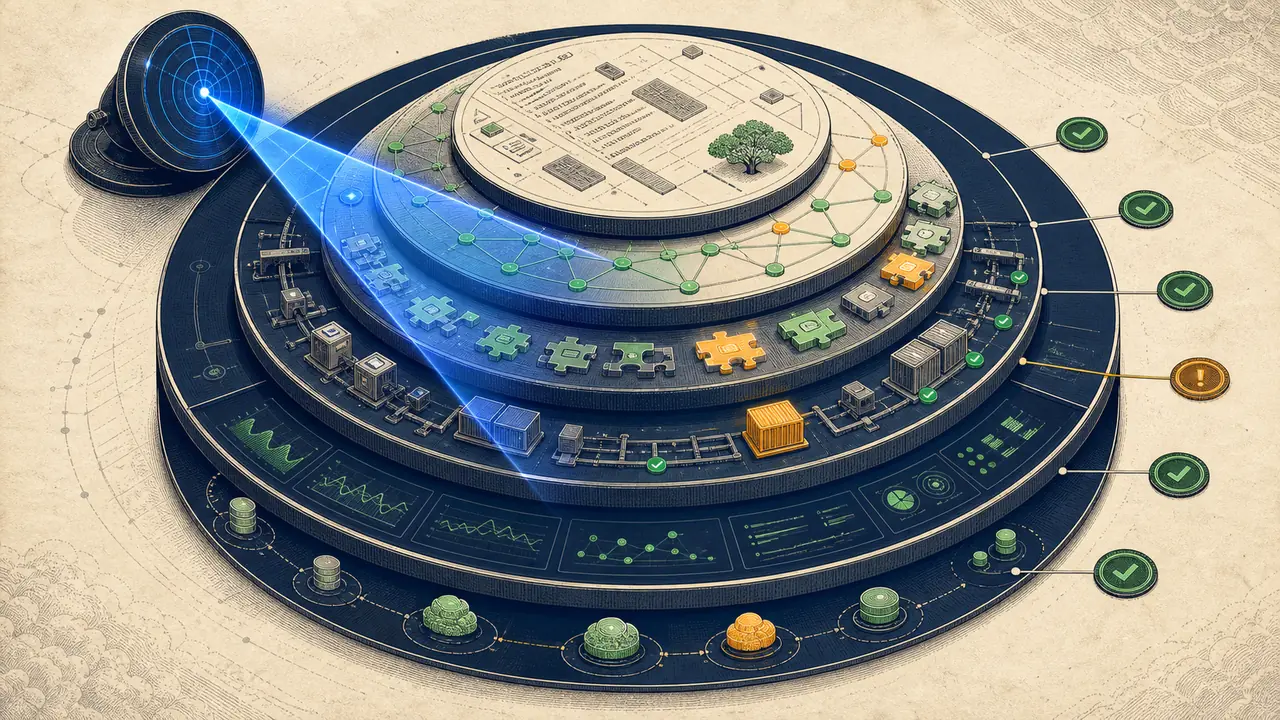
We are expanding Migration Packs from focused runtime transitions into a broader catalog of defined source-to-target changes. Each pack combines applicability conditions, deterministic analysis rules, evidence requirements, remediation guidance, validation expectations, rollout patterns, rollback conditions, and maintenance references. The objective is not a generic best-practice library; it is transition intelligence that can explain why a rule applies to a specific repository state.
Catalog work prioritizes transitions that create repeated cross-team planning cost: runtime and language upgrades, framework majors, database engines and versions, base images, build and delivery systems, cloud platforms, and shared infrastructure. Packs are versioned independently from the product so guidance can evolve with upstream releases while existing assessments remain reproducible.
How it works
Specify the transition boundary, supported variants, and exclusion conditions.
Create deterministic repository, dependency, infrastructure, and validation rules.
Test rules against representative projects and known compatibility scenarios.
Track upstream releases, deprecations, security changes, and rule performance.
Evidence produced
The capability produces structured evidence that can be reviewed by engineers and reused by downstream planning and verification.
Source versions, target requirements, environment, architecture, and stack conditions.
Compatibility, removed behavior, dependency, configuration, and infrastructure checks.
Tasks, ordering constraints, validation, rollout, and rollback recommendations.
Pack version, source references, coverage changes, and review history.
Operational impact
A larger maintained catalog shortens the distance from repository discovery to an executable plan. Teams begin with tested transition knowledge while retaining the evidence and flexibility needed to adapt it to their own architecture.
See it in a migration assessmentMigration control in practice
Start with the repositories, define the target transition, and see the technical and operational work required.