A Node.js runtime upgrade can look deceptively small in a pull request. One field changes in an engine declaration, a container tag moves to a newer release, and the lockfile records a few dependency updates. The operational reality is much larger. The runtime sits beneath application code, package managers, native extensions, test tools, build pipelines, container images, serverless platforms, observability agents, and the assumptions engineers have accumulated over years. Readiness therefore cannot be answered by asking whether the application starts on a laptop. It must be established through evidence that covers the entire delivery path.
This guide presents a rigorous way to prepare a Node.js upgrade, whether the target is a newer long-term support release or a broader modernization involving TypeScript, frameworks, and build tooling. The goal is not to remove every unknown before work begins. That is rarely possible. The goal is to identify material uncertainty, assign it to an owner, reduce it with the right test or experiment, and define the conditions under which production traffic may safely move. When those conditions are explicit, runtime modernization becomes an engineering program rather than a hopeful sequence of package updates.
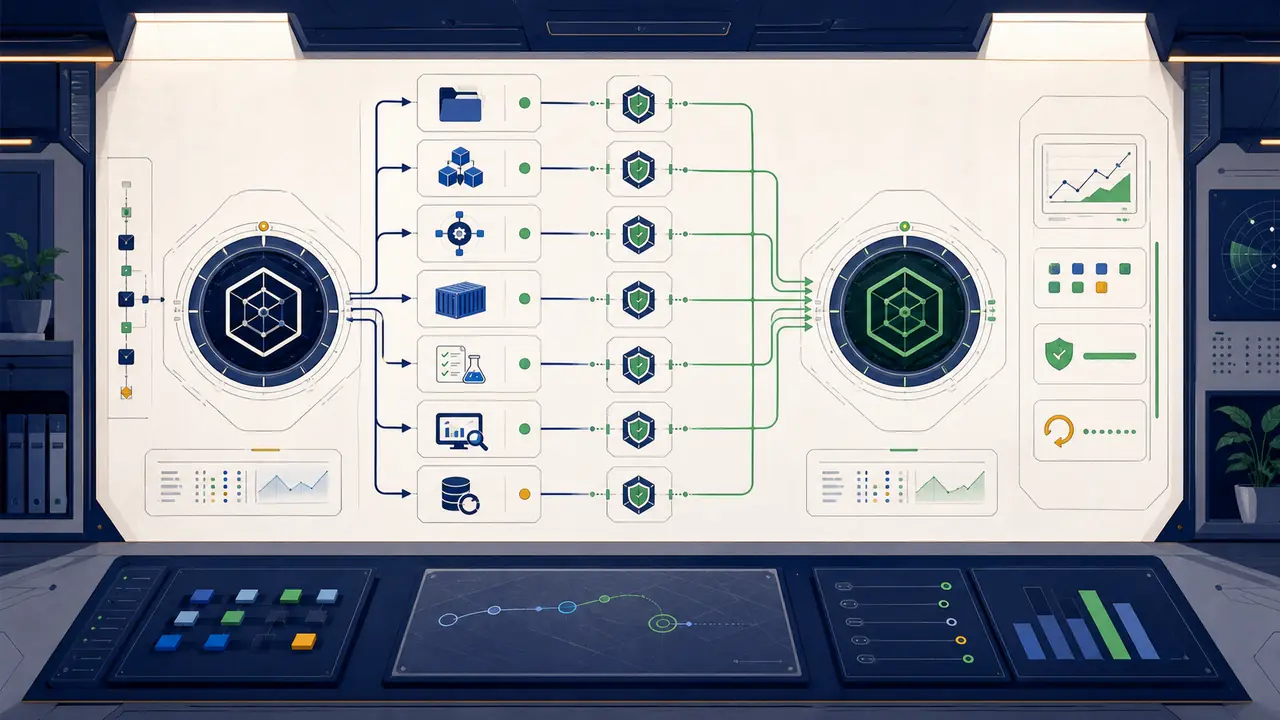
What runtime upgrade readiness actually means
Readiness is the degree to which a system and its operating organization can execute a defined migration without accepting unmanaged risk. It is not a single test result, a percentage detached from evidence, or a declaration that every dependency advertises support for the target runtime. A useful readiness model evaluates several dimensions at once: dependency compatibility, application behavior, test strength, delivery infrastructure, production observability, rollback capability, ownership, and execution sequencing.
These dimensions are related but not interchangeable. A service can have perfectly compatible dependencies and still be unready because its image build uses a retired base distribution. Another service can pass a comprehensive test suite but depend on an internal package whose maintainer and release process are unclear. A third can run correctly in staging yet lack the metrics needed to recognize a production regression. Treating all three as “green” hides different forms of exposure.
A practical readiness statement
For every service in scope, the target runtime is reproducibly built, its important behavior is verified, its operational health is observable, its dependencies are supported or consciously accepted, and a tested recovery path exists. Every exception has evidence, an owner, and a decision.
That statement is more valuable than an unsupported score because it tells teams what must be true. A score can still help leaders compare repositories and observe progress, but only when users can trace every component of the score to a rule, a repository, a commit, a file, a finding, and a validation result. Readiness should become more accurate as uncertainty is resolved, not merely increase because tasks were marked complete.
Define the source, target, and migration boundary
Begin with an exact source state. “We are on Node 16” is usually incomplete. Production may run one patch release, CI another, and developers several others. A monorepo may contain multiple container files and serverless configurations. Scheduled jobs may use a different image than request-serving services. Capture versions from every authoritative location: engine declarations, version manager files, Dockerfiles, CI actions, deployment manifests, platform settings, and runtime telemetry. Pin the assessment to commits so the findings remain reproducible while the repositories continue to change.
Define the target with equal precision. Name the Node.js major and minimum patch level, supported operating systems and architectures, package manager and version, base image family, and expected TypeScript compilation target. Decide whether the migration includes adjacent changes such as moving from CommonJS to ECMAScript modules, upgrading a framework, changing the test runner, or refreshing the Linux distribution. Bundling unrelated modernization into one program can hide causality. Separating it may create duplicate work. The correct boundary is the one that keeps failures diagnosable while avoiding a temporary configuration the organization cannot support.
Next, identify what is in scope. Repository lists are a starting point, not an architecture map. Include deployable services, workers, command-line tools, scheduled tasks, serverless functions, shared packages, code generators, deployment repositories, infrastructure modules, and maintenance scripts. Record owners, criticality, traffic patterns, deployment frequency, compliance constraints, and upstream or downstream dependencies. A small utility that signs tokens or compiles database migrations can be more critical to the program than a large web application.
- Record every runtime declaration and the production runtime actually observed.
- Choose a target runtime, operating system, architecture, package manager, and image family.
- Pin each analyzed repository and submodule to a specific commit.
- List deployables, shared packages, pipelines, infrastructure, and scheduled workloads.
- Document explicit exclusions and the reason each exclusion is safe.
- Assign a technical owner and operational owner to every production workload.
Build an evidence inventory before estimating
An upgrade plan is only as credible as its inventory. Automated discovery should parse manifests and lockfiles rather than relying on package names copied into a spreadsheet. The lockfile reveals the resolved dependency graph, including multiple versions of the same package and transitive components that are invisible in the top-level manifest. Workspace definitions reveal package boundaries. Import analysis shows where a dependency is actually used. Container and pipeline files show whether the runtime used for linting, building, testing, and production is consistent.
For every finding, preserve its evidence location. A useful record includes repository, commit, file path, line or structured configuration path, observed value, applicable migration rule, severity, confidence, and affected service. Evidence should be stable enough for an engineer to reproduce the conclusion and current enough to support planning. If the repository changes, rescan and show whether the finding was resolved, changed, or superseded.
Inventory tests as capabilities, not just files. Determine which services have unit, integration, contract, end-to-end, performance, and smoke tests; where those tests run; which environments they require; and whether failures block merging or deployment. Measure whether critical workflows are represented. A repository with thousands of unit tests may still have no protection against a change in HTTP connection reuse, cryptographic defaults, timer behavior, or serialization at a service boundary.
Also capture operational controls. Identify dashboards, service-level indicators, alert rules, log fields, traces, deployment health checks, feature flags, traffic controls, and rollback artifacts. These determine whether the team can detect and contain problems that static compatibility analysis cannot predict. The inventory should expose unknowns directly. “No owner found,” “production version not observed,” and “contract coverage not established” are actionable findings, not gaps to silently omit.
Analyze dependencies, native modules, and installation behavior
Dependency compatibility requires more than comparing an engine range. Inspect direct and transitive packages, resolved versions, release support policies, known runtime constraints, and the paths through which each package reaches a deployable. A package that is compatible in isolation may be locked behind an older parent dependency. Two workspaces may resolve different major versions. An internal library may declare broad support while its own CI tests only the existing runtime.
Prioritize native modules because their risk differs from ordinary JavaScript packages. Packages built with Node-API can often span runtime versions, but compatibility still depends on the Node-API level used, prebuilt binary availability, operating system, C library, CPU architecture, and fallback compilation. Packages tied directly to the V8 or Node ABI typically require a binary built for the exact runtime line. If no compatible prebuild exists, installation may invoke a compiler toolchain that is absent from the production build image or blocked by restricted network access.
Run clean, script-controlled installations in an isolated environment that matches production. Capture whether packages download binaries, compile source, execute lifecycle scripts, or access external hosts. Do not treat a developer machine’s warm cache as evidence. Validate both the build architecture and production architecture, especially when Apple Silicon development, x86 build agents, and Linux production coexist. Inspect image layers to confirm that build-only compilers and credentials do not remain in the final image.
Transitive risk deserves explicit ownership. If a nested package is incompatible, the action may be to upgrade a direct parent, replace a library, contribute a fix, use an approved override, or isolate the affected capability. Every override should have an expiration condition and a verification test. Blindly forcing a newer transitive version can satisfy installation while violating assumptions in the parent package.
Check application code and changed runtime behavior
Runtime release notes provide a starting point for code analysis, but a useful assessment converts changes into repository-specific checks. Search for removed or deprecated APIs, changed defaults, stricter input validation, differences in URL and HTTP handling, cryptographic algorithm availability, TLS behavior, stream semantics, module resolution, timers, buffers, and error shapes. Rules should identify evidence and explain why it matters, not simply flag every reference to a broad API.
Module systems often create hidden coupling. Determine which packages use CommonJS, native ECMAScript modules, transpiled modules, dynamic imports, conditional exports, or custom loaders. Inspect the combination of package type declarations, file extensions, TypeScript module settings, test transforms, bundler configuration, and published package exports. A runtime change can expose an ambiguity that tooling previously tolerated. Validate both source execution and packaged artifacts because the code tested in a workspace may differ from what consumers install.
Behavioral tests should target important boundaries. Exercise request parsing, authentication, database connectivity, queue consumption, file handling, streaming, graceful shutdown, background jobs, timeouts, retries, and external API clients. Compare the current and target runtimes using representative inputs. When behavior differs, determine whether the new result is a defect, a deliberate runtime correction, or an application assumption that must change.
Performance also belongs in application readiness. New runtimes may improve throughput while changing memory profiles, garbage collection pauses, startup time, or CPU behavior under specific workloads. Benchmark representative traffic with consistent infrastructure and warm-up rules. Focus on service-level thresholds rather than celebrating a synthetic microbenchmark. Record baseline variance so a normal fluctuation is not mistaken for a regression or improvement.

Upgrade the complete delivery system
The runtime used in production is only one link in the chain. CI actions can embed their own Node.js runtime. Build images can use tags that silently move. Deployment scripts, infrastructure tools, code generators, and test runners may execute under a different version. Find every runtime pin and decide whether it belongs to the application target, a vendor-managed action, or an independent toolchain. Make each pin explicit and explain exceptions.
Prefer immutable image references and reproducible package installation. Lock the package manager version, use frozen lockfile modes, and fail when manifests and lockfiles disagree. Confirm that base images receive security updates and that required system libraries remain available. If the target changes the Linux distribution or C library, treat that as a separate compatibility axis. Scan both the application dependencies and the resulting image.
Build the target runtime in parallel before making it the only path. A temporary CI matrix can run tests on current and target versions, revealing differences without blocking the existing release flow. Keep the matrix long enough to capture flaky and environment-dependent behavior, then remove the old lane after cutover so it does not become permanent maintenance. For shared packages, publish candidate versions and verify them with real consumers rather than relying solely on package-local tests.
Strengthen validation, observability, and rollback
Validation should mirror the failure modes identified during discovery. Unit tests protect local logic; integration tests protect databases, queues, caches, and file systems; contract tests protect service boundaries; end-to-end tests protect essential user journeys; and performance tests protect operational thresholds. Each important finding should connect to a test or a documented manual validation. A generic “test suite passed” checkbox cannot replace that traceability.
Define production signals before deployment. At minimum, compare error rate, latency percentiles, throughput, saturation, restarts, memory, CPU, event-loop delay, garbage collection, dependency errors, queue lag, and business-critical outcomes. Segment signals by runtime version or deployment cohort so a canary can be compared with the existing fleet. Decide the observation window and thresholds in advance. Teams make better decisions when they are not inventing acceptable error rates during an incident.
Rollback must be executable, not aspirational. Preserve the previous deployable artifact, configuration, infrastructure compatibility, and database expectations. Verify that the deployment platform can shift traffic back within the required recovery time. If the migration includes irreversible data or protocol changes, a simple image rollback may be unsafe; use backward-compatible expansion and contraction, dual reads, or versioned contracts. Run the rollback procedure in a production-like environment and record the result.
Unknown is a valid status
When evidence is missing, classify the gate as unknown or pending instead of passing it by default. Then create the smallest investigation that can resolve the uncertainty: a clean install, consumer test, architecture check, load run, or rollback exercise.
Sequence the work in migration waves
A dependency-aware sequence reduces rework. Start with a safety baseline: confirm inventory, ownership, critical workflows, observability, and rollback. Prepare the toolchain next by making the target runtime available in local development, CI, and image builds. Upgrade shared internal packages before their consumers, because downstream teams need stable candidate releases and compatibility guidance.
Choose early services for learning value, not only low business importance. A useful pilot resembles later workloads, has strong tests and observability, and can be rolled back easily. Apply what the pilot reveals to rules, estimates, documentation, and templates. Then move through cohorts based on dependency order, operational criticality, team capacity, and shared failure domains. Avoid migrating every instance of a shared dependency simultaneously; staged exposure preserves comparison and containment options.
Each wave should state entry criteria, tasks, owners, evidence, validation steps, exit criteria, and rollback conditions. Track blockers separately from general tasks. Rescan repositories as work merges so plans reflect current code rather than the initial assessment. Readiness can decrease when a new dependency or configuration appears; that is a useful signal, not a scoring failure.
Use explicit gates for production cutover
A cutover decision should assemble technical and organizational evidence into a concise record. Confirm that builds are reproducible, required test suites pass, critical contracts are exercised, performance remains inside agreed limits, production monitoring distinguishes cohorts, rollback artifacts exist, on-call owners are available, and approvals are recorded. Include remaining accepted risks with a named decision owner and an expiration or follow-up condition.
During rollout, increase exposure in deliberate steps. Evaluate the agreed signals after each step and pause automatically or procedurally when thresholds fail. Keep the old runtime capacity available until the observation window completes. After full traffic moves, continue monitoring long enough to catch periodic jobs, memory growth, certificate operations, scheduled maintenance, or traffic patterns that a brief canary did not exercise.
Completion includes cleanup. Remove the old CI lane, obsolete images, temporary overrides, compatibility flags, and deprecated configuration. Update development documentation and runtime policies. Confirm that new repositories inherit the target through templates and policy checks. Review estimate accuracy, unexpected findings, validation effectiveness, and rollback performance. Feed those outcomes into the next migration so institutional knowledge becomes reusable evidence rather than another document that ages in a folder.
A runtime upgrade should leave the system easier to change
The strongest Node.js upgrade programs do more than reach a supported version. They create a reliable map of the software estate, make compatibility decisions explainable, strengthen validation around important behavior, and establish a reusable cutover discipline. That capability reduces the cost of the next runtime, framework, database, or delivery-platform migration.
Start with a commit-pinned inventory and a precisely defined target. Trace dependencies to deployables, give native code special attention, test behavior at system boundaries, and include CI, images, infrastructure, observability, and rollback in the same plan. Sequence work through evidence-backed waves, then allow production traffic to move only when explicit gates pass. This is what readiness means in practice: not certainty, but controlled change with visible facts, owned decisions, and a recovery path.
Turn your Node.js upgrade into an executable plan
CutoverGrid maps repository evidence, blockers, effort, migration waves, and production gates in one continuously updated assessment.
Book a CutoverGrid demo Explore Migration Packs