Teams often declare rollback ready because a deployment platform can select the previous application image. That capability matters, but it covers only one piece of recovery. A runtime or framework upgrade can change dependency resolution, container bases, startup commands, configuration semantics, database access, generated output, protocol behavior, and operational thresholds. Restoring old code while those surrounding states remain new can create a second failure.
A credible rollback plan starts with a target recovery state, identifies every transition that can prevent that state, and verifies the sequence under representative conditions. It defines measurable triggers and gives one role authority to act. It also distinguishes rollback from forward repair. Some changes cannot be reversed safely; hiding that fact inside optimistic language leaves operators without a decision model when time matters most.
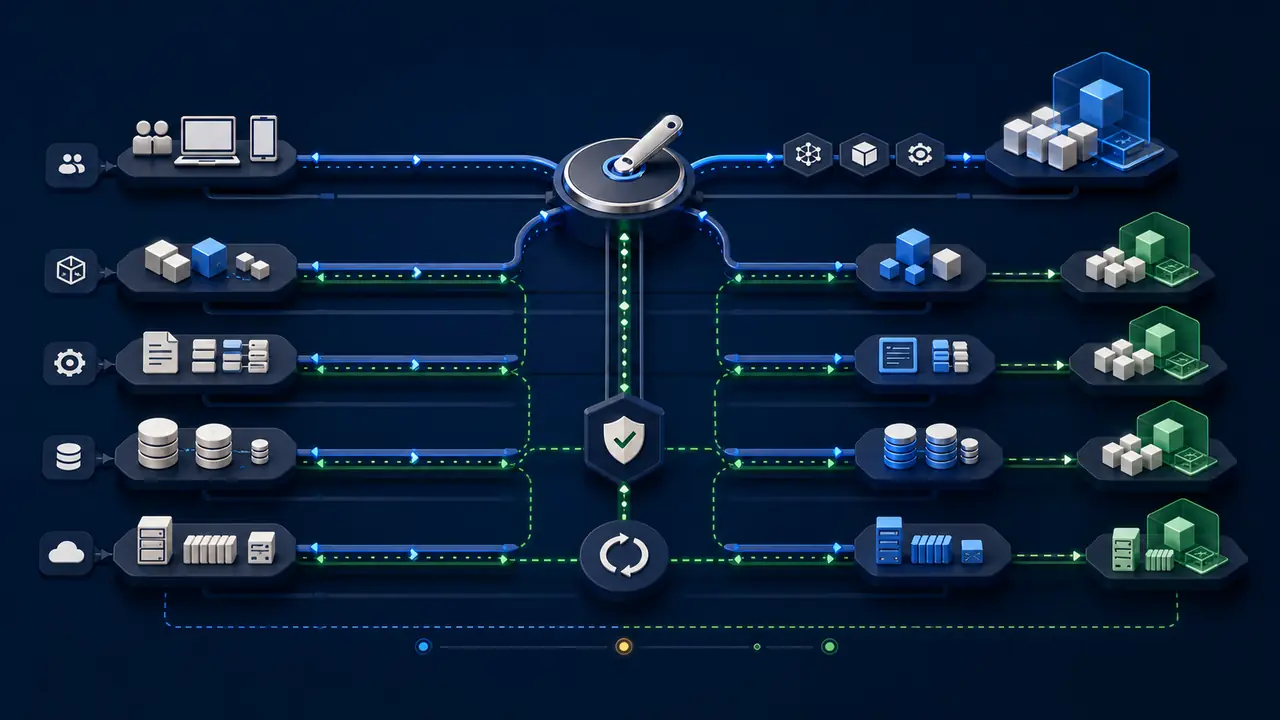
This article provides a control framework for runtime and framework migration rollback. It covers failure definitions, technical layers, data and distributed compatibility, artifact retention, runbook design, rehearsal, and the evidence required at a production cutover gate.
What rollback means for a modernization
Rollback means returning the affected production capability to a defined known-good state within an agreed recovery objective. “Affected capability” is deliberately broader than a process. It may include application instances, workers, scheduled jobs, routing, feature flags, schemas, messages, secrets, certificates, infrastructure, and external integrations. The target state should name the versions and configuration expected after recovery.
Reversibility exists on a spectrum. A stateless service deployed from an immutable image behind a load balancer may be straightforward to restore. A framework change that emits a new event schema, rewrites persisted data, rotates keys, or changes session serialization can cross a point after which the previous code no longer handles current state. The plan must locate these points before cutover.
Recovery time has components: detection, decision, execution, stabilization, and verification. Teams frequently estimate only deployment duration. If an hour passes before a regression becomes visible, a five-minute image swap does not produce a five-minute recovery. Instrumentation and decision authority are part of rollback performance.
Rollback scope should match migration scope. A phased migration needs recovery at each wave boundary. A coordinated cutover may require a full-system sequence. If a service depends on a newly upgraded shared package or protocol, restoring it alone may not recover behavior. Map the dependency path that must return with it.
Rollback is ready only when the old state is available, compatible, authorized, executable within the objective, and verifiable through agreed health signals.
Define failure and decision thresholds first
A rollback plan cannot be precise until the team defines unacceptable outcomes. Functional failure is obvious when requests error, but runtime regressions can appear as elevated tail latency, memory growth, event-loop delay, connection exhaustion, queue lag, worker starvation, increased restart rate, or incorrect business outcomes. Framework changes can affect routing, serialization, caching, authentication, error handling, and middleware order without producing a simple crash.
Choose signals that represent user and system health. Include service-level indicators, critical transaction success, error class, latency percentiles, saturation, resource usage, backlog, data correctness probes, external dependency behavior, and business guardrails. Establish source-state baselines so a target threshold reflects real variability rather than guesswork.
For each signal, record a threshold, observation window, evidence source, owner, and action. Instantaneous noise should not trigger unnecessary reversal, while a long window can consume the recovery budget. Some conditions require immediate rollback—corrupted output, security control failure, or broad unavailability—while performance drift may allow a short diagnostic pause.
Set a time-based decision point. If the team cannot establish a safe forward fix before a defined deadline, rollback begins even when the exact root cause remains unknown. This prevents incident pressure from turning into endless diagnosis while exposure continues.
Name the decision authority and backups. Observers provide evidence; service owners interpret domain behavior; an incident or cutover lead decides. A requirement for broad consensus slows action and makes accountability ambiguous. Everyone should know who can stop rollout, initiate rollback, or declare that reversal is no longer safe.
Plan rollback across every changed layer
Application and runtime
Preserve the exact known-good artifact, not merely a source tag that requires rebuilding. Record its digest, runtime, entrypoint, dependencies, and provenance. Confirm the deployment controller can select it and that capacity exists to restore the required instance count. If the runtime is supplied by the host rather than the artifact, preserve the host image or environment configuration as well.
Configuration and secrets
Runtime upgrades can introduce new environment variables, flags, certificate paths, connection options, or configuration schemas. Identify which values are backward compatible. Version configuration with the release where possible, and define the restoration order. Secret rotation deserves special attention: the old application may not accept a new credential format, while reverting a secret can break already migrated consumers.
Infrastructure
Review compute architecture, base operating system, container runtime, serverless runtime selection, health probes, resource limits, autoscaling, network policy, storage, and identity permissions. Infrastructure rollback may have a different mechanism and lead time from application deployment. A changed machine image or managed runtime cannot always be reversed instantly.
Delivery system
Preserve the workflow and permissions used to deploy the known-good state. A migration may update central templates, action versions, runner images, package registries, or signing steps. The emergency job must still run after those changes. Verify that protected-environment approvals and break-glass procedures work for the operators assigned to cutover.
Observability
Dashboards, queries, alerts, and log parsing can change with the application. Keep rollback verification independent of fields or metrics that exist only in the new state. Operators need to see whether old instances have returned, traffic has shifted, backlogs are draining, and user outcomes are stable.
Protect data compatibility and identify irreversible points
Data is the most common reason application rollback fails. An upgraded service may write a schema the old version cannot read, change serialization, remove a field, reinterpret values, migrate sessions, or emit messages with new semantics. The plan must examine both stored data and data in motion.
Prefer expand-and-contract changes when feasible. First add structures or fields that both versions tolerate. Deploy code that can read old and new forms while writing a compatible form. Backfill with observable, restartable jobs. Switch usage only after validation. Remove old structures after the rollback window closes and every consumer has moved.
For database migrations, classify operations as backward compatible, conditionally compatible, or irreversible. Adding a nullable column is often easier to reverse than changing type, rewriting values, or dropping a column, but actual behavior depends on code and database constraints. Test the old application against the post-migration schema. Do not infer compatibility from migration syntax alone.
Message queues create delayed compatibility. Old messages may remain after new producers deploy; new messages may reach old consumers during rollback. Use versioned schemas, tolerant readers, and explicit dead-letter handling. Record the maximum retention or processing delay that defines how long mixed-version compatibility must remain.
Cache and session formats deserve the same analysis. A framework upgrade may change serialization or cookie behavior. Decide whether caches can be invalidated safely, whether users can be reauthenticated, and whether mixed instances can share the same session store. These are product-impact decisions, not only infrastructure details.
When a change cannot be reversed, define forward recovery. Preserve backups or snapshots, validate restoration time, prepare repair scripts, and require a stronger go or no-go gate. State the last responsible moment for rollback explicitly. Operators should never discover during an incident that the safe reversal window ended earlier.
Coordinate rollback across distributed dependencies
Services rarely upgrade alone. A runtime migration can require shared package releases, base-image changes, protocol adjustments, and infrastructure updates. Map which target-state components remain compatible with source-state consumers and vice versa. This compatibility matrix determines whether one service can roll back independently.
Backward-compatible interfaces make phased recovery possible. Providers can often add fields or endpoints without breaking older consumers, then remove old behavior after migration. Breaking contract changes create coupled rollback groups. If several services must move and recover together, represent them as one operational boundary and rehearse the complete order.
External dependencies introduce constraints outside direct control. A vendor API version, certificate policy, identity provider, or managed runtime may not support reversal on demand. Record vendor windows, escalation paths, rate limits, and fallback modes. Do not list an external action in the runbook unless its availability and authorization are known.
Traffic routing can reduce exposure and improve recovery. Canary, blue-green, regional, or cohort rollouts keep a known-good path active while the target state is observed. Verify that routing control itself is reversible, that sessions and data remain compatible, and that dashboards distinguish cohorts. A traffic switch is not safe rollback when both groups write incompatible data.
Feature flags can separate deployment from activation, but flags require lifecycle control. Confirm defaults, evaluation failure behavior, propagation latency, ownership, and removal conditions. A stale flag or unavailable control plane can undermine the recovery path.
Verify artifact retention, integrity, and access
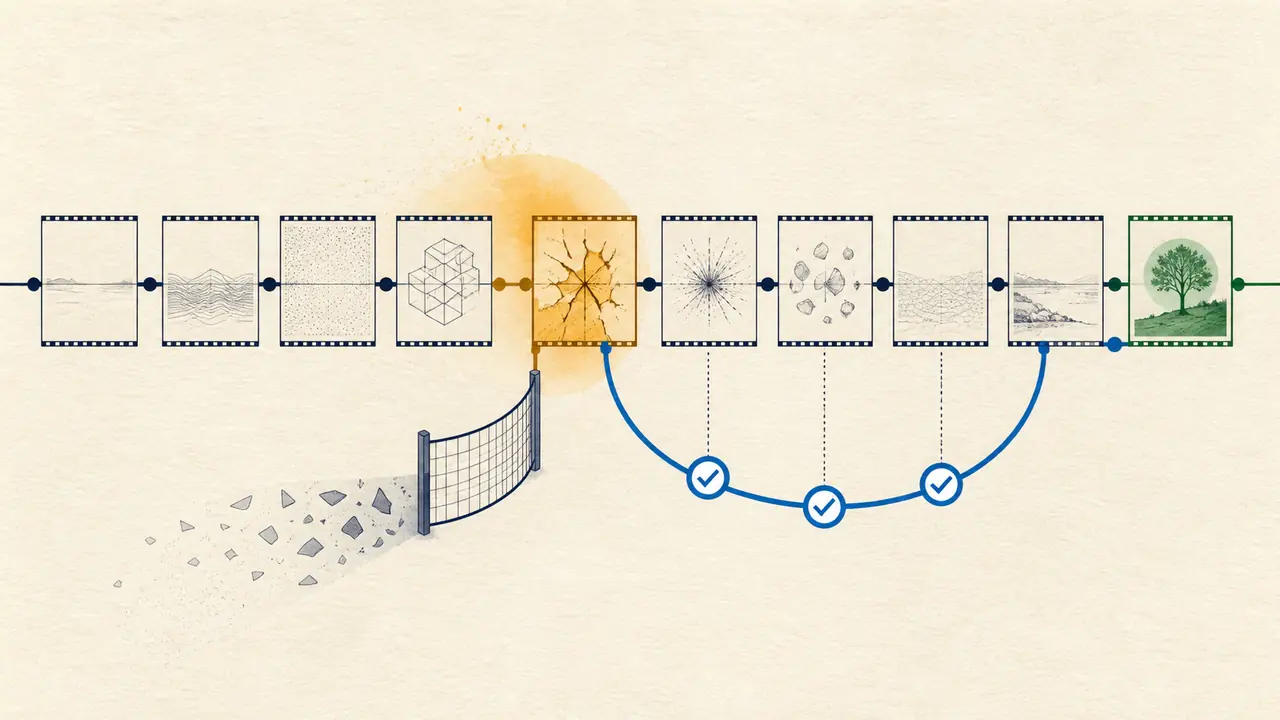
The known-good artifact should be immutable and traceable to source commits, workflow revision, runtime version, dependency lockfile, and base-image digest. Confirm registry retention covers the entire rollback window. Test that cleanup policies, mutable tags, or image replication cannot remove or replace it.
Keep associated configuration and infrastructure revisions. Restoring an application image against incompatible templates or secrets may fail. A release manifest can bind the artifact, configuration revision, infrastructure version, migrations, and expected environment into one recovery reference.
Validate access from the production path. The artifact may exist but be unavailable to the target region, cluster identity, or emergency operator. Check registry authentication, network policy, signing verification, protected-environment approvals, and deployment permissions. Run these checks using the identities that will act during cutover.
Estimate restoration capacity. If rollback requires replacing a large fleet, verify registry throughput, scheduling capacity, startup time, health checks, and connection ramp-up. A technically valid image that takes longer than the recovery objective to restore does not meet the control.
Build an executable rollback runbook
A runbook should begin with scope and assumptions: affected services and environments, source and target versions, data compatibility window, dependencies, and decision authority. Follow with preconditions that can be checked before cutover, including artifact availability, backup status, access, dashboards, communication channels, and staffing.
Write steps as exact actions with expected results. Name the console, command, workflow, manifest, or controller used, but avoid embedding credentials. After each step, specify the signal that confirms progress and the action if it fails. Include ordering and safe parallelism. Numbering alone does not prove that two operations can run concurrently.
Define communication points. Notify stakeholders when rollout begins, when a stop condition occurs, when rollback is authorized, when old capacity is restored, and when health is confirmed. Separate technical execution from broad communication so operators are not distracted by ad hoc status requests.
Include post-rollback stabilization. Draining or replaying queues, invalidating caches, reconciling partial writes, restoring autoscaling, confirming scheduled jobs, and maintaining heightened observation may be necessary. Recovery is complete only when the service returns to the defined known-good operating state.
Record evidence as the runbook executes: timestamps, actors, artifact digests, deployment results, dashboard links, queries, thresholds, and exceptions. This supports review and proves which state actually reached production.
Rehearse, time, and challenge the plan
Execute rollback in a representative environment using the same artifacts, controllers, identities, and sequence. Measure each stage. Rehearsal often exposes missing permissions, expired artifacts, hidden manual steps, slow capacity, incompatible configuration, and health checks that cannot distinguish old from new.
Test the data boundary, not only deployment. Generate target-state records or messages, then restore the old application and verify behavior. Run long-lived jobs, delayed events, and sessions that cross the transition. If production volume matters, validate restoration timing and resource behavior at representative scale.
Challenge assumptions through scenarios: registry unavailable, one region delayed, migration job partially complete, monitoring signal missing, cutover lead unavailable, or vendor response slow. The objective is not theatrical chaos. It is to find single points where the recovery path depends on an unverified condition.
Set evidence freshness. A rehearsal from months earlier may not prove current readiness after workflows, permissions, or infrastructure change. Rescan and revalidate affected controls when repositories or environments drift. Critical artifact and access checks can run immediately before cutover.
Plan the return to normal delivery
Rollback can leave a service healthy while the engineering system remains in an exceptional state. Document how to reopen normal deployment, restore automation, clear temporary routing rules, reconcile configuration, and resume scheduled work. Decide whether target-runtime changes stay on the main branch behind controls, are reverted, or move to a remediation branch. Protect the restored production version from being overwritten by the next routine release.
Define the evidence required to close the incident and restart migration work. Confirm data reconciliation, backlog recovery, user-impact review, alert status, artifact retention, and ownership of follow-up actions. Preserve logs and deployment records before ephemeral environments disappear. The next attempt should begin from a new assessment of the actual repository and production state, not from the assumptions recorded before rollback.
A rollback review should compare detection time, decision time, execution time, stabilization time, and expected values. Identify which signals were useful, which instructions were ambiguous, and which permissions or dependencies slowed recovery. Convert each lesson into an owned improvement with acceptance criteria, then re-rehearse the affected portion. Recovery capability is maintained through evidence just like the migration itself.
Keep recovery controls available after a successful cutover for the defined rollback window. Continue retaining artifacts, compatible schemas, operational staffing, and heightened monitoring until exit criteria prove they can be removed. Announce when that window closes and which forward-recovery plan replaces it. Cleanup before the formal boundary can turn a recoverable late regression into an irreversible incident.
Rollback readiness checklist
- The target known-good state is documented across every affected layer.
- Functional, operational, security, and data failure conditions are measurable.
- Decision authority, backups, stop conditions, and time limits are explicit.
- The previous artifact is immutable, retained, traceable, and accessible.
- Configuration, secrets, infrastructure, and delivery revisions remain compatible.
- Database, message, cache, session, and contract compatibility are tested.
- Irreversible changes and the last reversible point are clearly identified.
- Distributed components can recover independently or are grouped deliberately.
- Dashboards and probes verify both rollback progress and restored health.
- The runbook contains exact actions, expected results, and failure branches.
- Required identities and permissions have executed the recovery path.
- Restoration duration, capacity, and stabilization fit the recovery objective.
- Representative data and delayed work have crossed a rehearsal safely.
- Evidence is fresh at the commit and environment used for cutover.
Conclusion
Rollback planning is the engineering work of preserving a verified path to a known-good operating state. For runtime and framework upgrades, that path spans far more than application deployment. It includes data compatibility, messages, configuration, infrastructure, shared dependencies, delivery systems, observability, access, staffing, and decision authority.
Define failure before cutover, locate irreversible points, retain complete artifacts, write measurable actions, and rehearse with representative conditions. Attach every claim to current evidence and rescan when the system changes. When rollback is treated as a cutover gate rather than a reassuring sentence, teams can modernize with faster decisions and materially stronger control.
Make rollback a verified cutover gate.
CutoverGrid connects application, data, infrastructure, ownership, and operational evidence to the rollback conditions required for production change.